Static FEA is most valuable when you need fast, defensible answers to one core question: Will the product safely carry its intended loads—without unnecessary cost, weight, or redesign risk?
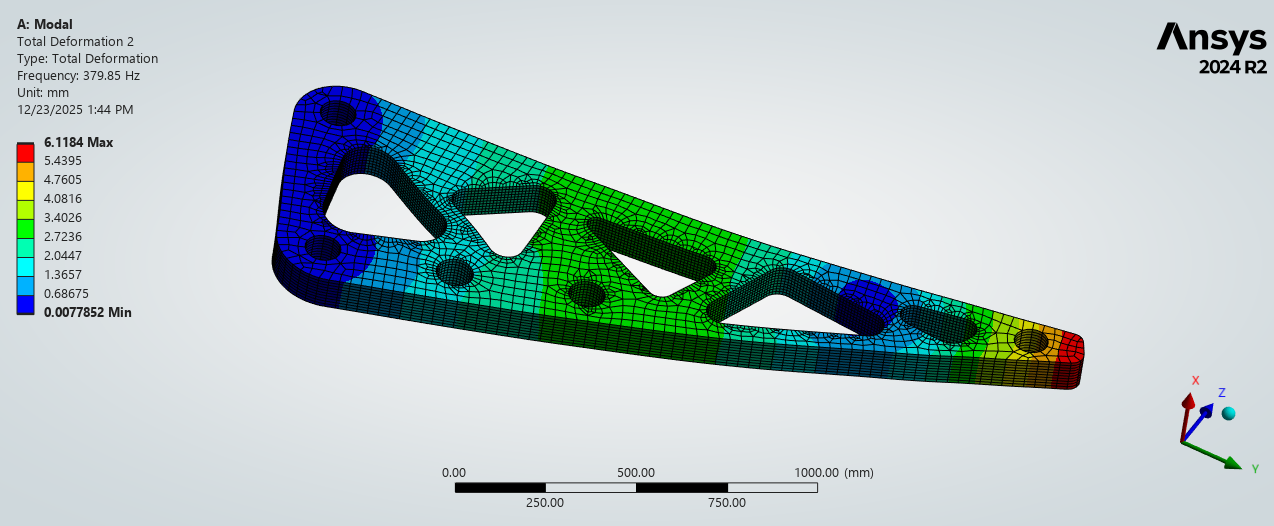
Static analysis helps validate strength and stiffness early—before costly prototype loops.
What “Static FEA” Means (In Business Terms)
Static finite element analysis predicts stress and deformation when loads are applied slowly or steadily—so the product has time to settle into equilibrium. This makes static FEA a cost-effective first line of validation for strength and stiffness.
Best-fit load types
- Weight / gravity loads (fixtures, enclosures, brackets)
- Internal pressure (vessels, housings, manifolds)
- Bolt preload and clamp loads
- Assembly forces (press-fit, connector insertion)
- Steady thermal expansion (sealed packages, stacks)
What decision makers get
- Early go/no-go confidence on a concept
- Fewer prototype iterations
- Reduced late-stage redesign and schedule slips
- Material and weight optimization with evidence
- Clear documentation for customers and compliance
Where Static FEA Delivers the Highest ROI
1) Early concept & feasibility (before prototyping)
Use static FEA early to eliminate weak concepts and avoid investing engineering time into designs that cannot meet strength or stiffness requirements.
An electronics enclosure must support a PCB, heat sink, and cable harness. Static FEA quickly identifies weak mounting bosses and excessive wall deflection—so the team adds ribs or fillets before tooling or prototype orders.
2) Detailed design verification (before design freeze)
As designs mature, static FEA becomes your verification tool to confirm stress margins, displacement limits, and safety factors under defined load cases.
A mounting bracket must maintain alignment under equipment weight and fastener loads. Static FEA highlights stress concentration near bolt holes; small geometry changes (thickness, washer seat, fillet radius) prevent yielding and improve stiffness.
3) Cost & weight optimization (targeted, not guesswork)
Overdesign quietly increases BOM cost, shipping costs, and system-level constraints. Static FEA enables controlled light-weighting by showing where material is doing real work—and where it is not.
A metal housing is failing weight targets. Static FEA reveals large low-stress regions. The design removes material selectively while keeping high-stress zones reinforced.
4) Pre-prototype risk reduction (avoid test surprises)
Prototypes are expensive. Static FEA is a fast risk screen to identify likely failures before the first build.
A press-fit connector region sees high assembly loads. Static FEA predicts local plastic deformation risk; the team adjusts wall thickness and support features before prototyping.
5) Compliance, customer assurance, and design documentation
Many industries require evidence-backed structural justification. Static FEA provides traceable results that can be included in engineering reports, customer deliverables, and internal sign-off packages.
A pressure-bearing component is documented with stress maps and factors of safety under operating pressure, supporting internal review and customer confidence.
6) Failure investigation and fast redesign loops
When failures occur, static FEA is often the fastest route to root cause—especially when the failure is tied to stress concentration, poor load paths, or unexpected deformation.
A cracked corner in a housing is traced to a sharp internal edge. Static FEA confirms peak stress and validates a fillet redesign before releasing the next revision.
A simple “Use Static FEA When…” checklist
- You need to evaluate strength (stress vs. yield/allowable).
- You need to evaluate stiffness (deflection, alignment, sealing, clearances).
- Loads are steady or slowly applied (gravity, pressure, clamp, assembly).
- You want to reduce prototype iterations and prevent late redesign.
- You want to optimize cost/weight with confidence.
When static FEA is not enough
Static FEA is foundational, but it does not replace analyses dominated by time effects, inertia, or repeated loading. If your primary risk is one of the following, you likely need additional analysis:
Use dynamics
- Drop / impact → explicit dynamics
- Vibration / resonance → modal / harmonic response
Use lifecycle / thermal
- Repeated loading → fatigue assessment
- Time-varying temperature → transient thermal + coupled analysis
How Tetra Elements helps
Tetra Elements supports product teams with decision-ready static FEA focused on reducing risk, cost, and development time. Typical deliverables include:
- Stress and deformation results tied to real load cases
- Design recommendations (geometry, materials, fasteners, load paths)
- Optimization options (cost/weight) with tradeoff guidance
- Report-ready documentation for internal review and customers
Want a quick feasibility check or a full verification package?
Send your CAD + load notes and we’ll propose the right workflow (static only vs. coupled analyses). We’re ready to sign an NDA.
Note: Static analysis assumes loads are applied slowly enough that inertia effects are negligible. For impact, vibration, fatigue, or transient thermal concerns, we recommend a combined analysis plan.